All-Russian 2007
This post shows a nice application of Hilbert's Basis Theorem, the proof of which can be found in the previous post.
Problem 1 (All-Russian 2007)
Do there exist non-zero reals \(a\), \(b\), \(c\) such that, for any \(n>3\), there exists a polynomial \(P_{n}(x) = x^{n}+\dots+a x^{2}+bx+c\), which has exactly \(n\) (not necessary distinct) integral roots?
Proof. Let us first show the following result,
Lemma 1.1
There are no \(n\) and \(m\) such that \(P_n \mid P_m\) and the ratio has zero \(x\) and \(x^2\) terms.
Since both \(P_n\) and \(P_m\) have the same last coefficients, it must be that, \[ (\ldots + ax^2 + bx + c) \cdot (\ldots + dx^2 + ex + f) = \ldots + ax^2 + bx + c \] trivially it means that \(f = 1\), \(b = ce + bf = ce + b\) and \(a = af + be + cd = a + be + cd\), however this implies that \(d = e = 0\)!
Observe, that by Vieta (looking at \(c\)) it must be that \(P_n(x) = (x - 1)^{\alpha_n} (x + 1)^{\beta_n} Q_n(x)\), where \(\deg Q\) has bounded degree. Observe, that thus by Veita (for \(c\)) there exists some \(Q\) such that there are infinitely many \(k\) such that \(Q_k = Q\).
Let us look for all of those same class \(P_n\) (where the class is \(Q_n\)) and look at the pairs \((\alpha_n, \beta_n)\). Let us assume that \((\alpha_n, \beta_n) < (\alpha_m, \beta_m)\) (less in both coordinates), then this will imply that, that \(P_n \mid P_m\) and the ratio is of the form \((x - 1)^{\alpha} (x + 1)^{\beta}\).
Lemma 1.2
The \(x\) and \(x^2\) term of \((x - 1)^{\alpha} (x + 1)^{\beta}\) cannot both be zero.
Indeed, by looking at the \(x\) term we conclude that \(\alpha = \beta\) (if the coefficient is zero) and the coefficient in front of \(x^2\) up to sign is equal to \(\binom{\alpha}{2} + \binom{\beta}{2} - \alpha \beta\) which cannot be zero if \(\alpha = \beta\)!
Thus, if \((\alpha_n, \beta_n) < (\alpha_m, \beta_m)\) we obtain a contradiction. Let us now plot on the \(\mathbb{Z}^2_{\geq 0}\) the points, then all we need to show is the following result.
Lemma 1.3 (Infinite Chomp)
There is no infinite sequence of points \((x, y)\) such that no two are contained (so both coordinates less than the other) in each other.
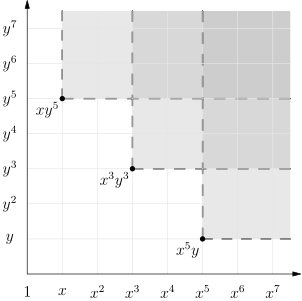
One can reinterpret the problem as drawing infinite rectangles to the up-right of a point and one is required to show that some two rectangles are contained in each other. Let us associate to each point the monomial \(x^{a} y^b\) where \(a, b\) are the coordinates of the point.
The infinite rectangle may be interpreted as the ideal generated by the monomial in the ring \(\mathbb{Z}[x, y]\), then by iteratively putting points on the plane one is creating larger and larger ideals, thus creating an infinite chain, \[ I_0 \subseteq I_1 \subseteq I_2 \subseteq \ldots \] however by Hilbert's Basis theorem we know that \(\mathbb{Z}[x, y]\) is Noetherian (since \(\mathbb{Z}\) is Noetherian), thus by definition this sequence must stabilize, which will imply that one point is contained in another!
This will give us the desired pair \(n, m\) with \((\alpha_n, \beta_n) < (\alpha_m, \beta_m)\) and thus we are done!
Consequently, no desired triple \((a, b, c)\) exists!