MrMineev
The Anchor Point Lemma
1 Theory
The Anchor Point Lemma is a series of configurations surrounding circles passing through D with well-defined intersections
with sides of a triangle.
-
1.
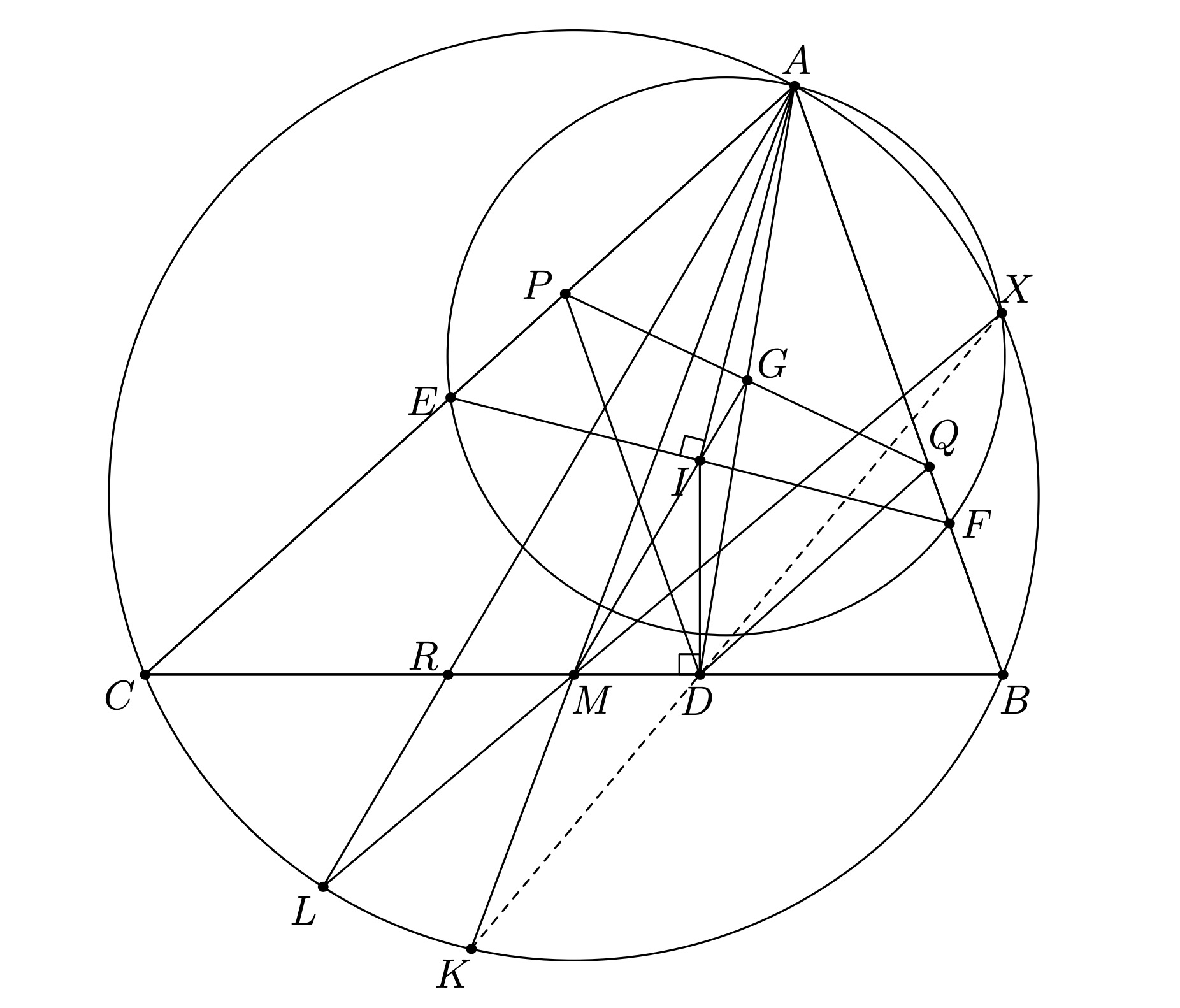
- (Anchor Point Lemma) Given a triangle
 , let
 be an arbitrary point on
 , then let
 and
 be parallel to
 and
 respectively. Let
 intersect
 at
 , let
 intersect
 at
 . Prove, that if
 is the midpoint of
 , then
 and
 are colinear.
-
2.
- (Generalized Anchor Point Lemma) Let
 be an arbitrary point on
 in
 . Let there be
two fixed directions
 and
 . Let
 and
 be the intersection of two lines through
 parallel to
 and
 with
 and
 . Let
 be the intersection of
 and
 . Prove that
 passes through a constant point X on
 .
Also prove that the circles  are all coaxial and the second constant point is the intersection of the circle
with the line isogonal to
 in
 with
 .
Remark 1.1 The circle (AGD) passes through a fixed point K on BC such that AK is isogonal to AX. If
P = CE ∩ BF then the line DP passes through a fixed point.
-
3.
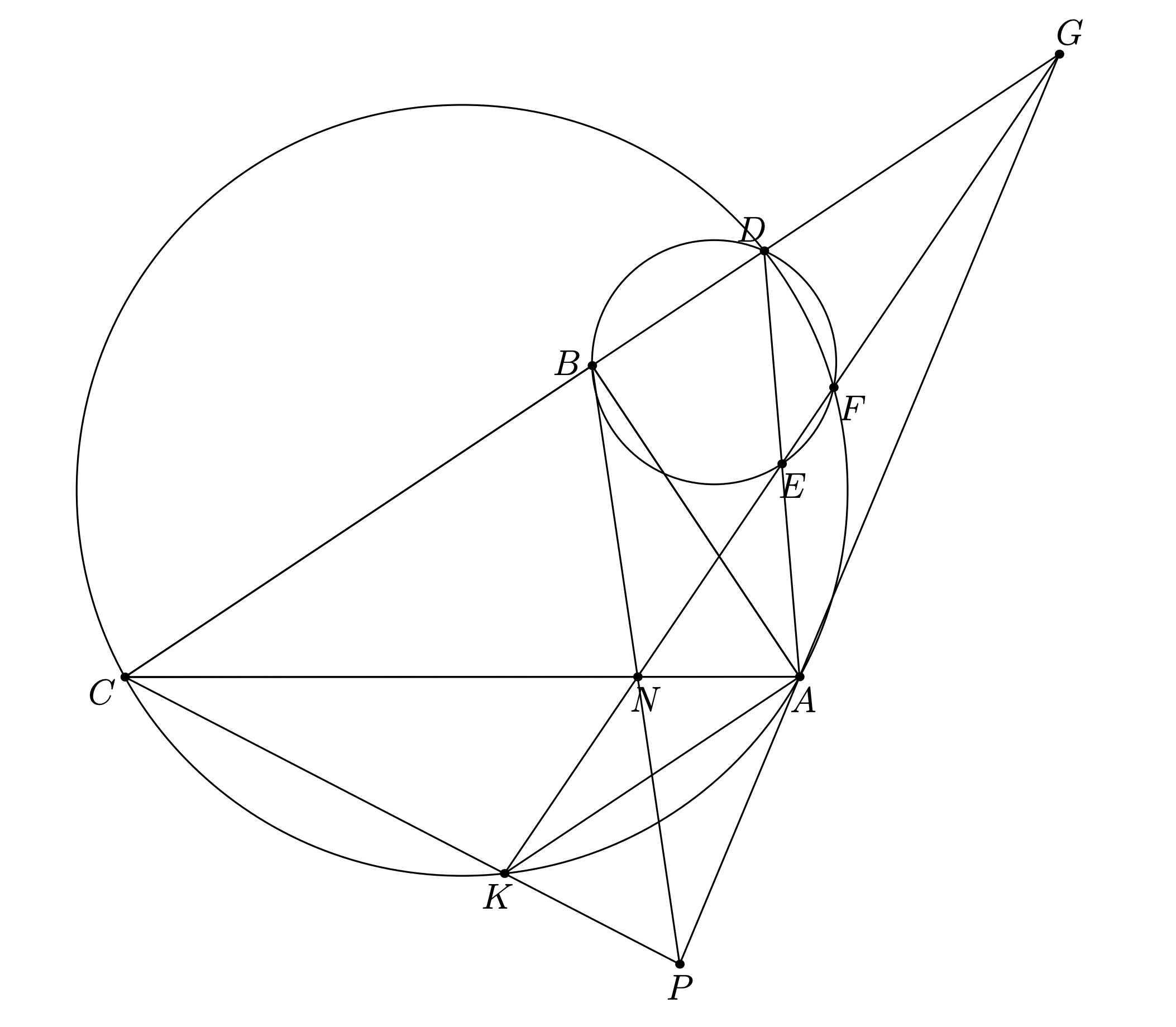
- (Advanced Anchor Point Lemma) Let
 be an arbitrary fixed point and
 an abitrary fixed point on
 . Let
 be an abritrary point on
 . Let
 intersect
 at
 . Let
 intersect
 at
 . Let
 intersect
 a second time at
 . Prove that the line
 passes
through a constant point
 as
 moves on
 , and that
 passes through a fixed point
 .
Remark 1.2 Similarly the to the previous lemma if P = CE ∩ BF then the line DP passes through a fixed
point.
Note: More details about this method can be found at https : ∕∕mrmineev.com∕articles∕anchor - point∕main.html
2 More Advanced Theory
Let AnchorPABC(E) be the Anchor Point conjugate of point P where E is the parameter. Notice,
-
1.
- AnchorE△ABC(AC) is a line which passes through C and the intersection of AE with the line through B parallel
to AC.
-
2.
- AnchorE△ABC(AB) is a line which passes through B and the intersection of AE with the line through B parallel
to AC.
-
3.
- Anchor(ABC)△ABC(P) is a line parallel to AC which passes through the intersection of the line through P
parallel to AB with BC.
-
4.
- Let
 be an arbitrary line in the plane then AnchorE△ABC() is a line which passes through ∩ BC.
In addition to these properties the cross-ratio is preserved.
3 Problems
-
1.
- (The Shooting Lemma) Consider the chord
 in the circle
 . Let the circle
 touch
 at a point
 and the circle
 at a point
 . Prove that the line
 passes through
 , the middle of the larger
arc
 .
-
2.
- (Sharky-Devil Config) Let
 be the incircle of
 , let
 be the tangency points of
 with
 and
 , respectively. Let
 be the second intersection of
 with
 . Let
 be the midpoint of the arc
 . Prove that
 and
 are colinear.
-
3.
- (USA TST 2008 P7) Let ABC be a triangle with G as its centroid. Let P be a variable point on segment BC.
Points Q and R lie on sides AC and AB respectively, such that PQ ∥ AB and PR ∥ AC. Prove that, as P varies
along segment BC, the circumcircle of triangle AQR passes through a fixed point X such that ∠BAG = ∠CAX.
-
4.
- (USA TST 2012 P1) In acute triangle ABC, ∠A < ∠B and ∠A < ∠C. Let P be a variable point on side BC.
Points D and E lie on sides AB and AC, respectively, such that BP = PD and CP = PE. Prove that as P
moves along side BC, the circumcircle of triangle ADE passes through a fixed point other than A.
-
5.
- (ELMO 2013 Shortlist G3) Given △ABC, a point D lies on line BC. The circumcircle of ABD meets AC at
F (other than A), and the circumcircle of ADC meets AB at E (other than A). Prove that as D varies, the
circumcircle of AEF always passes through a fixed point other than A, and that this point lies on the median
from A to BC.
-
6.
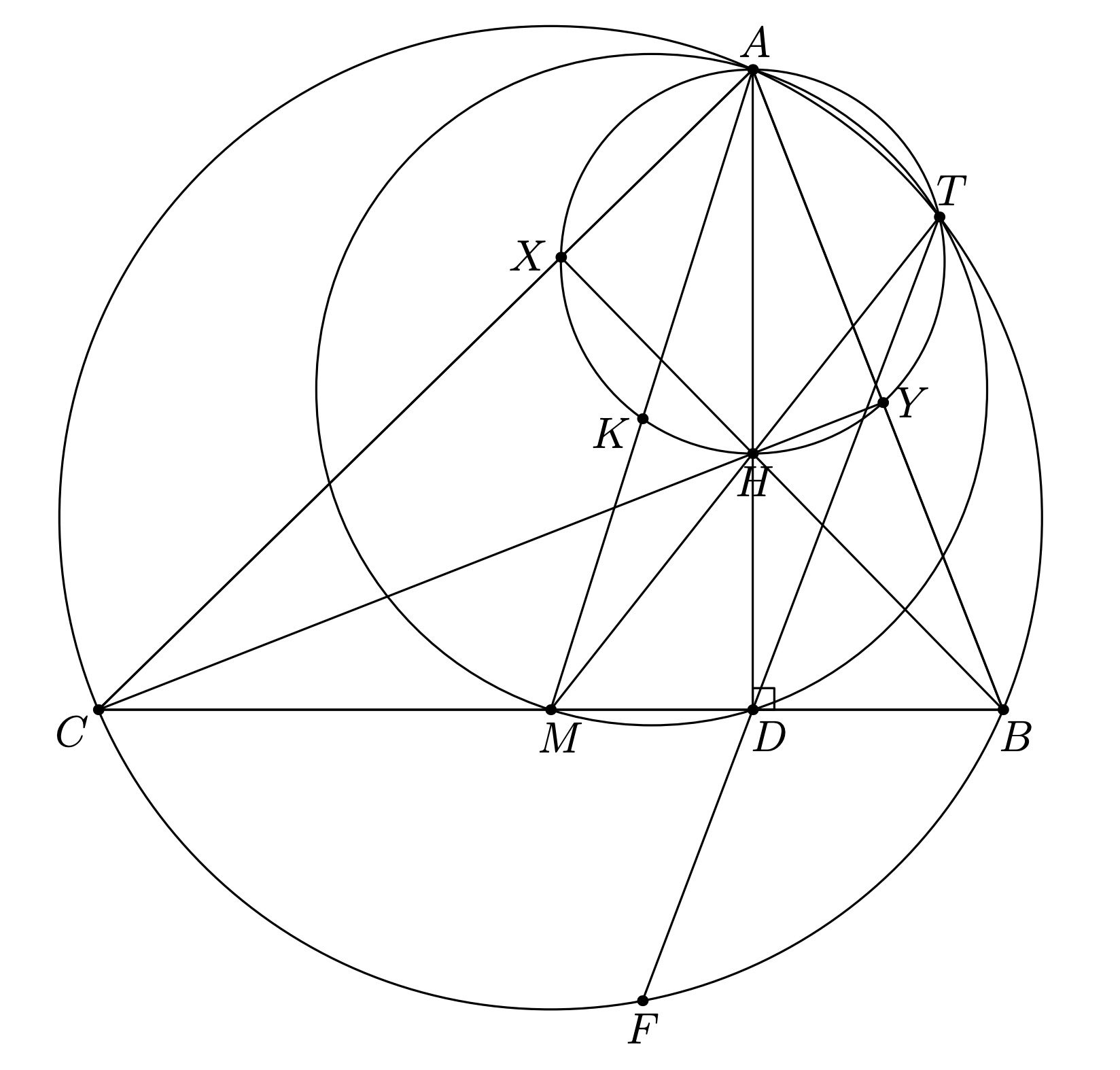
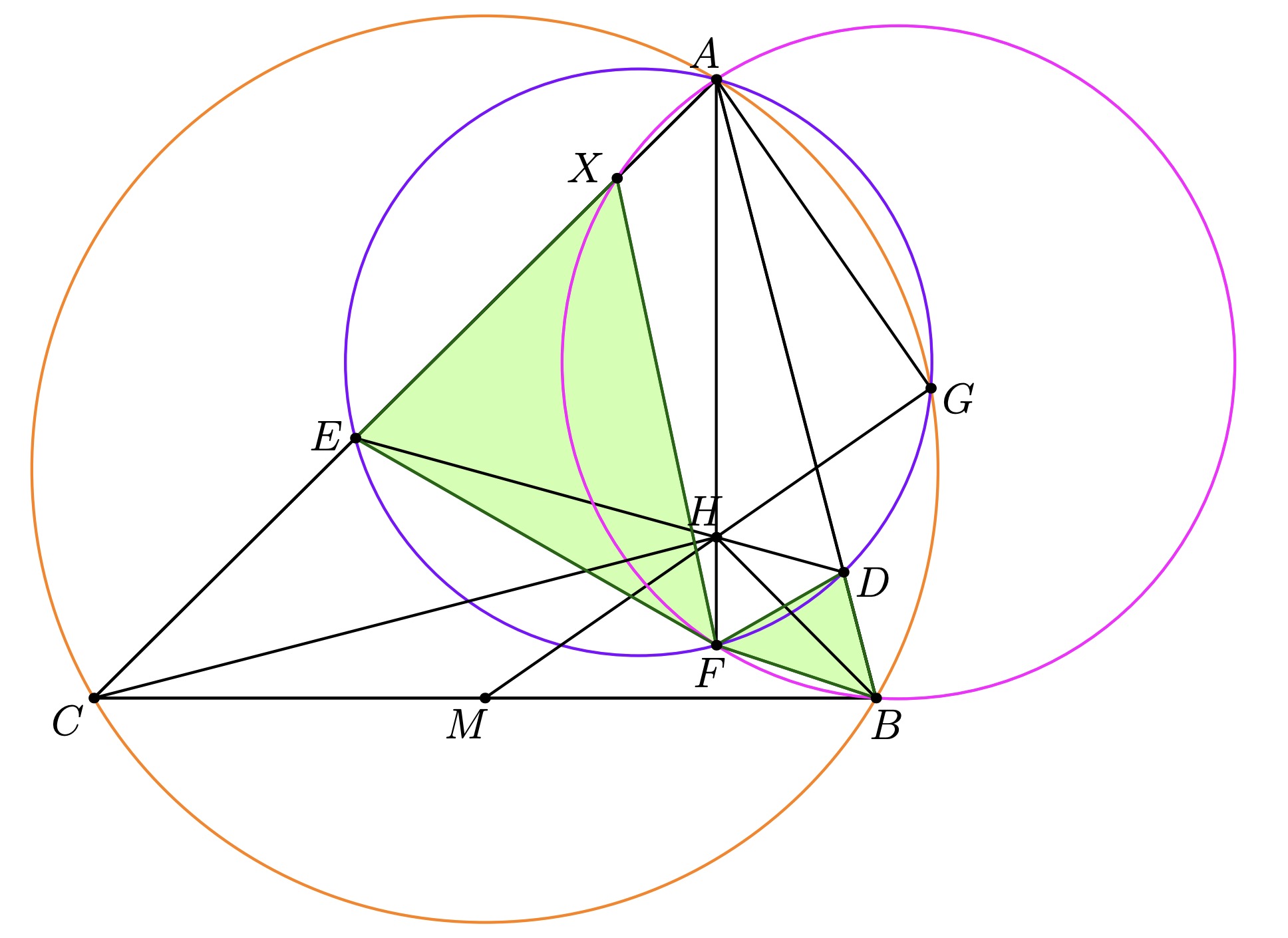
- (APMO 2012 P4) Let ABC be an acute triangle. Denote by D the foot of the perpendicular line drawn from the
point A to the side BC, by M the midpoint of BC, and by H the orthocenter of ABC. Let E be the point of
intersection of the circumcircle Γ of the triangle ABC and the half line MH, and F be the point of intersection
(other than E) of the line ED and the circle Γ. Prove that
 =
 must hold.
-
7.
- (based on Moscow Mathematical Olympiad 2015) Let △ABC be an isoseles triangle. Let P and Q be
points on sides AB and AC, respectively, such that BP = AQ. Let X be a point on BC such that PX = PB
and T be the second intersection of (APQ) with (ABC). Prove that ∠ATX = 90.
-
8.
- (IMO Shortlist 2016 G2) Let ABC be a triangle with circumcircle Γ and incenter I and let M be the midpoint
of BC. The points D, E, F are selected on sides BC, CA, AB such that ID ⊥BC, IE ⊥AI, and IF ⊥AI.
Suppose that the circumcircle of △AEF intersects Γ at a point X other than A. Prove that lines XD and AM
meet on Γ.
-
9.
- (BMO Shortlist 2017 G5) Let ABC be an acute angled triangle with orthocenter H. centroid G and circumcircle
ω. Let D and M respectively be the intersection of lines AH and AG with side BC. Rays MH and DG interect
ω again at P and Q respectively. Prove that PD and QM intersect on ω.
-
10.
- (APMO 2022 P2) Let ABC be a right triangle with ∠B = 90∘. Point D lies on the line CB such that B is
between D and C. Let E be the midpoint of AD and let F be the seconf intersection point of the circumcircle
of △ACD and the circumcircle of △BDE. Prove that as D varies, the line EF passes through a fixed point.
Let X be a point on the arc AB of Γ not containing C, such that ∠AXH = ∠AFH. Let K be the circumcenter
of triangle XIA. Prove that the lines AO and KI meet on Γ.
-
11.
- (IMO Shortlist 2005 G5) Let △ABC be an acute-angled triangle with AB ⁄= AC. Let H be the orthocenter of
triangle ABC, and let M be the midpoint of the side BC. Let D be a point on the side AB and E a point
on the side AC such that AE = AD and the points D, H, E are on the same line. Prove that the line HM is
perpendicular to the common chord of the circumscribed circles of triangle △ABC and triangle △ADE.
-
12.
- (by @SBYT) Given a triangle △ABC with an incenter I, let D be a point on segment BC. Let the perpendicular
line from D to CI meet BI at E and the perpendicular line from D to BI meet CI at F. Let the perpendicular
line from D to BC meet EF at G. Prove that the circles (ABC) and the circle centered at G with radius GD
are tangent.
4 Some of my Own
-
1.
- (AoPS) Let
 be an arbitrary point on the side
 of triangle
 . Let
 and
 be the
intersections of the lines through
 , parallel to
 and
 , with
 and
 , respectively. Let
 be the intersection point of the circumcircle of triangle
 with the circumcircle of triangle
 . Let
 be the midpoint of
 , and let
 be the second intersection point of line
 with the circumcircle
of triangle
 . Prove that lines
 ,
 , and the tangent to the circumcircle of triangle
 at
point
 are concurrent.
-
2.
- (AoPS) Let
 be an arbitrary point on the side
 in a triangle
 . Let
 and
 be the
intersection of the lines parallel to
 and
 through
 with
 and
 . Let
 be the
intersection of
 with
 . Let
 be the midpoint of
 and
 the intersection of
 with
 . Let
 be the intersection of
 with
 . Prove that
 is parallel to
 .
-
3.
- (AoPS) Let
 be an arbitrary point on the side
 in a triangle
 . Let
 and
 be the
intersection of the lines parallel to
 and
 through
 with
 and
 . Let
 be the
intersection of
 with
 . Let
 be the midpoint of
 and
 the intersection of
 with
 . Let
 be the intersection of
 with
 . Prove that
 ,
 and
 are
concurrent at
 .
5 A bit more theory...
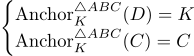
The Anchor Point Conjugate Theorem can be reformulated as,
Let these two points be called the Evil Anchor Point conjugates of D in △ABC with respect to F, which will be
denoted as EvilF,W△ABC(D) were W is either B or C depending on whether it is the point which lies on PX or
PY .
-
1.
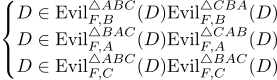
- (Evil Characterization) Let (ABD) meet lines AC and AF at X and Y , respectively, then EvilF,B△ABC(D) =
BX ∩ DY .
-
2.
- (AoPS) Prove that,
6 Extra (Unsolved)
-
1.
- (USEMO 2025 P2) Let ABC be a fixed triangle with circumcircle ω. Consider P a variable point inside ABC.
Ray BP meets side AC at Y while ray CP meets side AB at X. Let Q be the second intersection of ω and the
circumcircle of triangle AXY . Let K be the second interesction of ray AP and ω.
Prove that as P varies, the circumcircles of triangle QPK all have a common radical center.
7 Proposed Solutions to Some Problems
Problem 7.2 (USA TST 2012 P1)
In acute triangle ABC, ∠A < ∠B and ∠A < ∠C. Let P be a variable point on
side BC. Points D and E lie on sides AB and AC, respectively, such that BP = PD and CP = PE. Prove that as
P moves along side BC, the circumcircle of triangle ADE passes through a fixed point other than A.
Problem 7.3 (ELMO 2013 Shortlist G3)
n △ABC, a point D lies on line BC. The circumcircle of ABD meets AC at
F (other than A), and the circumcircle of ADC meets AB at E (other than A). Prove that as D varies, the circumcircle
of AEF always passes through a fixed point other than A, and that this point lies on the median from A to BC.
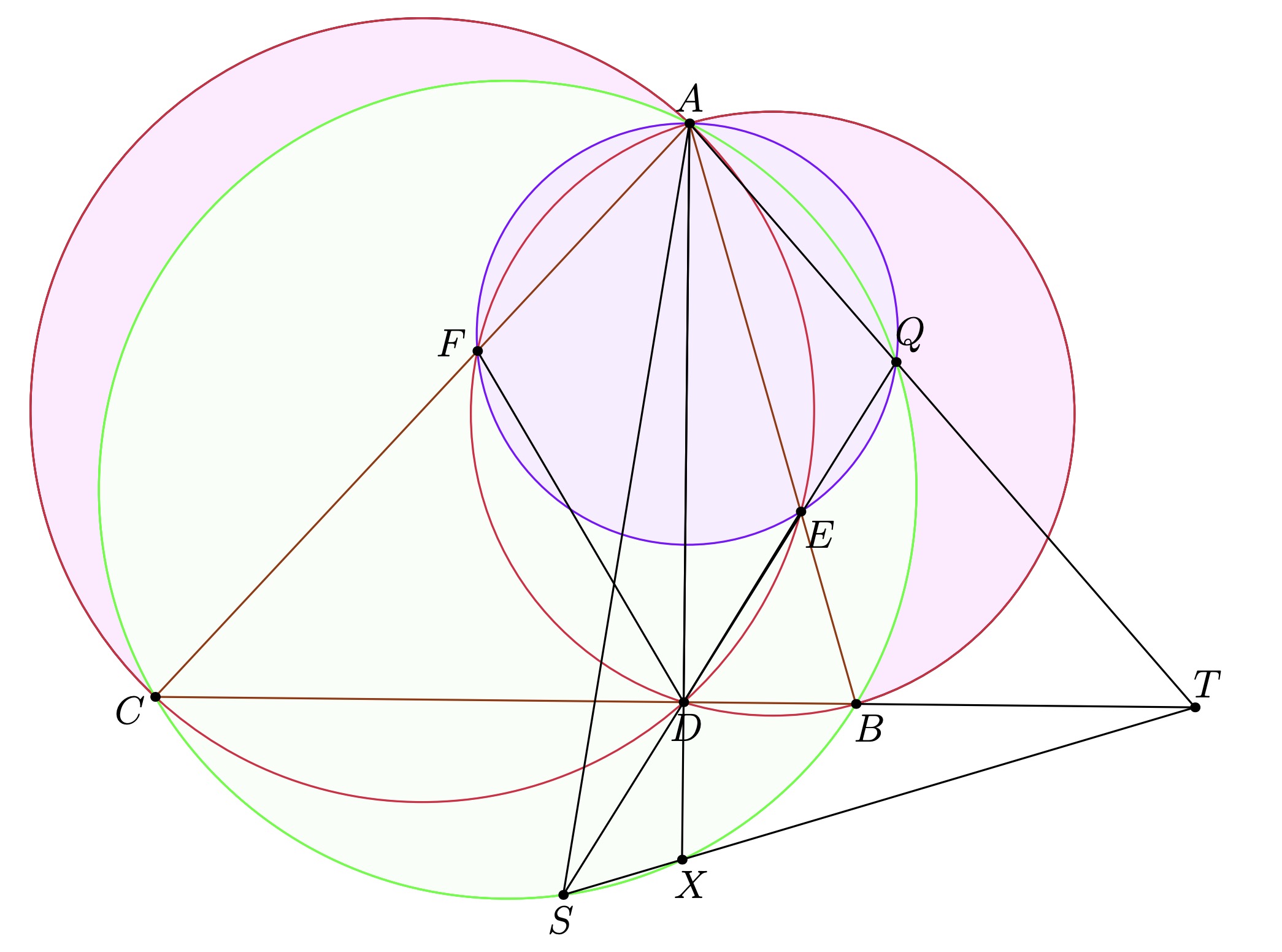
Proof. Notice,  and
 point in constant directions, since
 . Thus, by the Generalized
Anchor Point Lemma all we need to do is show for one position of
 that
 passes through some
fixed point on the median. Let us fix
 to be the foot of the altitude from
 to
 . Let
 be the
intersection of the symmedian from
 with
 , then, (it is well known, however the proof is outlined
below)
Lemma 7.1  are colinear.
indeed, since  is harmonic, by projecting from
 it must be that
 is harmonic, consequently projecting
from
 we obtain that
 goes to a point
 on
 such that
 is harmonic, thus
 , thus
 are colinear.

Now, by the Generalized Anchor Point Lemma since  are colinear, it must be that
 passes through a fixed
point lying on the isogonal line to
 in
 which is the median. ■
Problem 7.4 (IMO Shortlist 2016 G2)
Let ABC be a triangle with circumcircle Γ and incenter I and let M be the
midpoint of BC. The points D, E, F are selected on sides BC, CA, AB such that ID ⊥BC, IE ⊥AI, and IF ⊥AI.
Suppose that the circumcircle of △AEF intersects Γ at a point X other than A. Prove that lines XD and AM meet
on Γ.
Proof. Let K = AM ∩ (ABC). Let P and Q be the intersections of parallel lines through D with respect to AB and
AC with AC and AB, respectively.
Let L = MX ∩ (ABC), R = AL∩BC and G = PQ∩AD. From the Anchor Point lemma we know that GM ∥ AL,
however it is a well known lemma that M,I and G are collinear. Thus we see that MI ∥ AR and the reflection of D
over I lies on AR, consequntly it must be that M is the midpoint of RD.
Concluding by Butterly theorem we see that K,D and X are collinear. ■
Problem 7.5 (SBYT)
Given a triangle △ABC with an incenter I, let D be a point on segment BC. Let the
perpendicular line from D to CI meet BI at E and the perpendicular line from D to BI meet CI at F. Let the
perpendicular line from D to BC meet EF at G. Prove that the circles (ABC) and the circle centered at G with
radius GD are tangent.
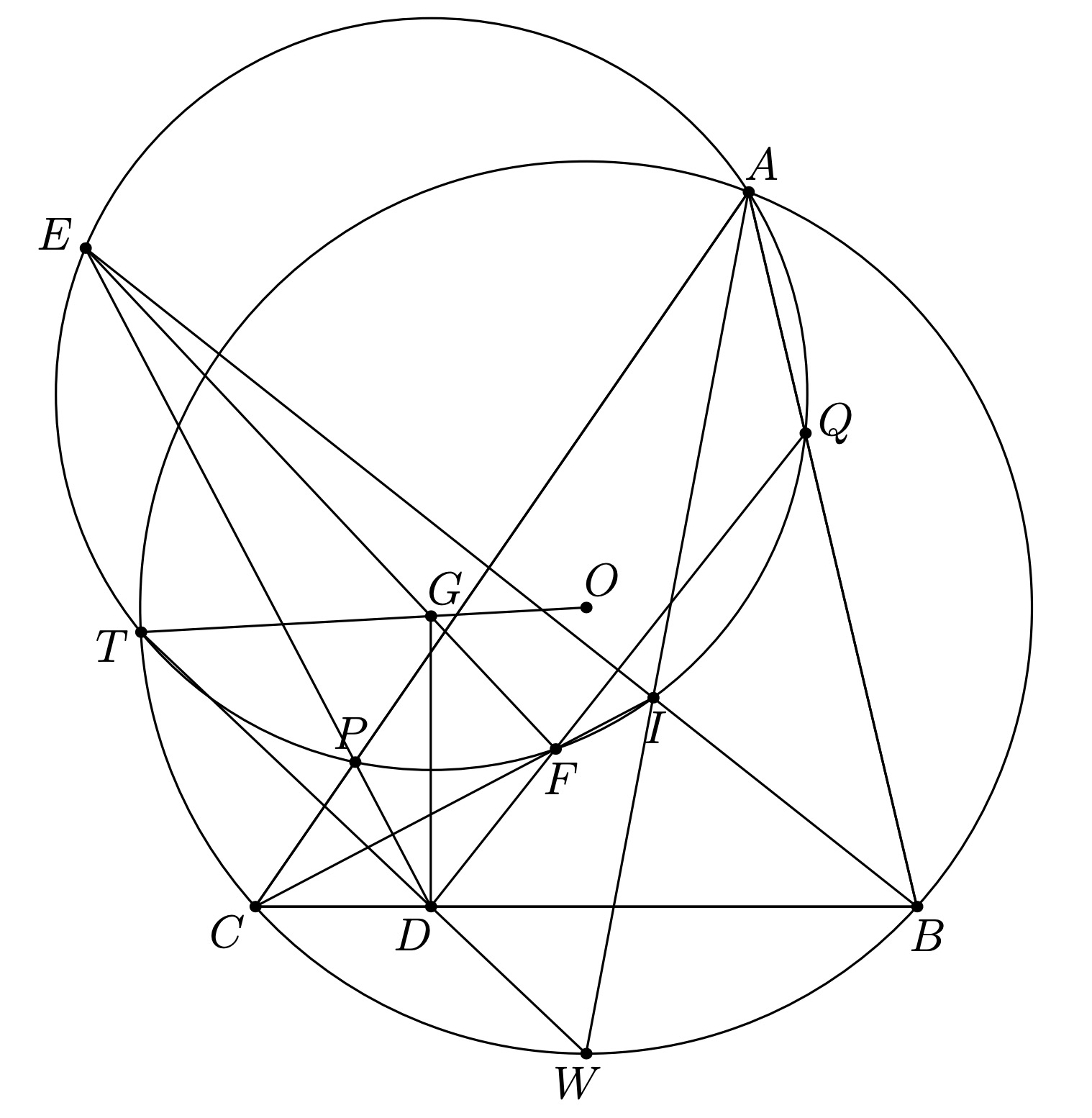
Proof. Let P = DE ∩ AC, Q = DF ∩ AB and T = DW ∩ (ABC), then notice that,
Lemma 7.2 AEQFPI is cyclic
Indeed, since P and Q are the reflections of D over CI and BI we know that,
and,
consequently APQEF is cyclic. By the Anchor Point Lemma we know that since as D moves PD and QD have constant
directions and when D is the projection of I onto BC by Sharky-Devil we know that TD passes through W the midpoint of
the arc BC. Thus TD always passes through W, but Anchor Point then tells us that the circle passes through a constant point
lying on the isogonal conjugate of AW in ∠CAB which implies that since I lies on the circle when D is the projection that I
always lies on the circle. □
Thus, since TD passes through W all we have to show to prove that (GD) is tangent to (ABC) is that T,G,O are collinear,
where O is the circumcenter of △ABC.
If D moves with degree 1 on BC then T moves with degree 2, similarly points F and E move with degree 1.
Thus, the line EF moves with degree 2 and the line l (perpendicular from D to BC) moves with degree 1.
Thus, G moves with degree 3. Thus, to show that T,G,O are collinear it sufficies to consider 2 + 3 + 1 = 6
cases.
Consider D being equal to B, C, the midpoint of BC, the projection of I onto BC (then one needs to prove that the
reflection of D over G lies on (APQ) which is trivial by angle chase), AI ∩ BC and finally ∞BC.
Consequently since T,G,O are collinear and T,D,W are collinear it must be that (GD) is tangent to (ABC). ■
Problem 7.6 (APMO 2012 P4)
Let ABC be an acute triangle. Denote by D the foot of the perpendicular line drawn
from the point A to the side BC, by M the midpoint of BC, and by H the orthocenter of ABC. Let E be the point
of intersection of the circumcircle Γ of the triangle ABC and the half line MH, and F be the point of intersection
(other than E) of the line ED and the circle Γ. Prove that  =
 must hold.
Proof. Notice, it is well know that T is the A-Queue point of △ABC. Thus, if X and Y are the feet of the altitudes
from B and C it must be that AXHY T is cyclic. Notice, by ELMO 2013 Shortlist G3 we obtain that since AY DC
and AXDB are cyclic, consequently we know that (AXY ) passes through a fixed point on the median, by Generalized
Anchor Point we know that DT passes through the point F on (ABC) such that AF is the symmedian, thus ABFC
is harmonic and the problem statement follows. ■
Remark 7.3 The problem can also be solved by noticing that by Generalized Anchor Point since ATMD is cyclic
(since ∠ATM = ∠ADM = 90) it must be that TD passes through a point on (ABC) isogonal to AM w.r.t. ∠CAB.
Problem 7.7 (APMO 2022 P2)
Let ABC be a right triangle with ∠B = 90∘. Point D lies on the line CB such that
B is between D and C. Let E be the midpoint of AD and let F be the seconf intersection point of the circumcircle of
△ACD and the circumcircle of △BDE. Prove that as D varies, the line EF passes through a fixed point.
Proof. Let K be such that CDAK is a trapezoid.
Let G be the reflection of C over B. Then let P = AnchorK△ABC(G) then is known that the Anchor Point conjugates
of points on CD will lie on CK, thus P ∈ CK. However, it is also known that the Anchor Point transformation
preserves cross-ratios which in the case of lines, implies the preservation of ratios thus since,
thus we know that from the preservation of ratios that DK ∥ GP, however AG ∥ DK, thus G,A and P are collinear
and K,E,G are collinear.
Then let N = PB ∩ AC, trivially N ∈ KG, however now due to the definition of the Anchor Point conjugate
K ∈ NF which implies that G ∈ EF. ■
Problem 7.8 (IMO Shortlist 2005 G5)
Let △ABC be an acute-angled triangle with AB ⁄= AC. Let H be the
orthocenter of triangle ABC, and let M be the midpoint of the side BC. Let D be a point on the side AB and E a
point on the side AC such that AE = AD and the points D, H, E are on the same line. Prove that the line HM is
perpendicular to the common chord of the circumscribed circles of triangle △ABC and triangle △ADE.
Proof. Let X = (AFB)∩AC and F = AH ∩(AED). Since AF is the isogonal line of AA′ (where A′ is the antipode),
then we know that the Evil Anchor Point conjugates of F with respect to A′ are some infinity points.
Thus, by the Evil Anchor Point characterization theorem we must only show that BX ∥ EM, which is equivalent to E is the
midpoint of CX. Notice,
Indeed since ∠EXF = ∠ABF and ∠XEF = ∠FDB. □
Similarly,
Indeed, since ∠CEH = ∠HDB and ∠ACH = ∠ABH. □
Consequently we know that,
the desired result now trivially follows,
thus CE = EX. ■
§
💬 Comments
 and an arbitrary point
 in the plane. Let
 be a circle passing through
 and
 . Let
 and
 be the second intersection points of
 with
 and
 , respectively. Let
 be the second intersection of
 with the circumcircle
 , and define

 varies, the lines
 and
 each pass through a fixed point.

 be the incircle of
 , let
 be the tangency points
of
 with
 and
 , respectively. Let
 be the second intersection of
 with
 . Let
 be the midpoint of the arc
 . Prove that
 and
 are colinear.
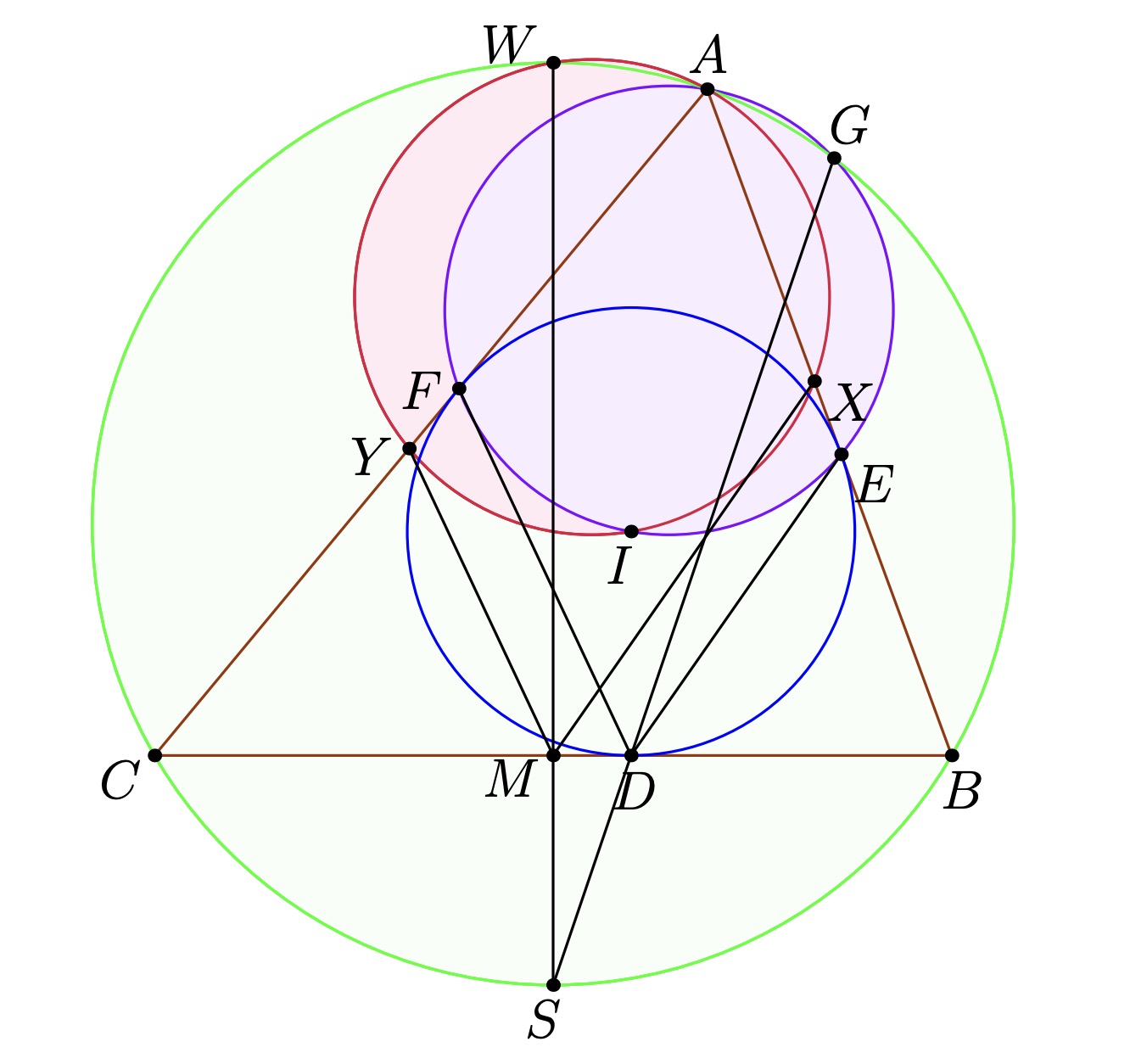
 the midpoint of
 and
 the midpoint of the larger arc
 . Then, let
 and
 be the intersections of the lines through
 parallel to
 and
 with
 and
 , respectively.
By the Generalized Anchor Point Lemma all that is left to prove is that
 is cyclic.


 , however this is only true for
 being the midpoint of the larger
arrc
 . Thus
 is cyclic which proves one of the properties of the Sharky-Devil point. (Amusingly
 lies on this circle as well due to
 and
 lying on the angle bisector of
 ).
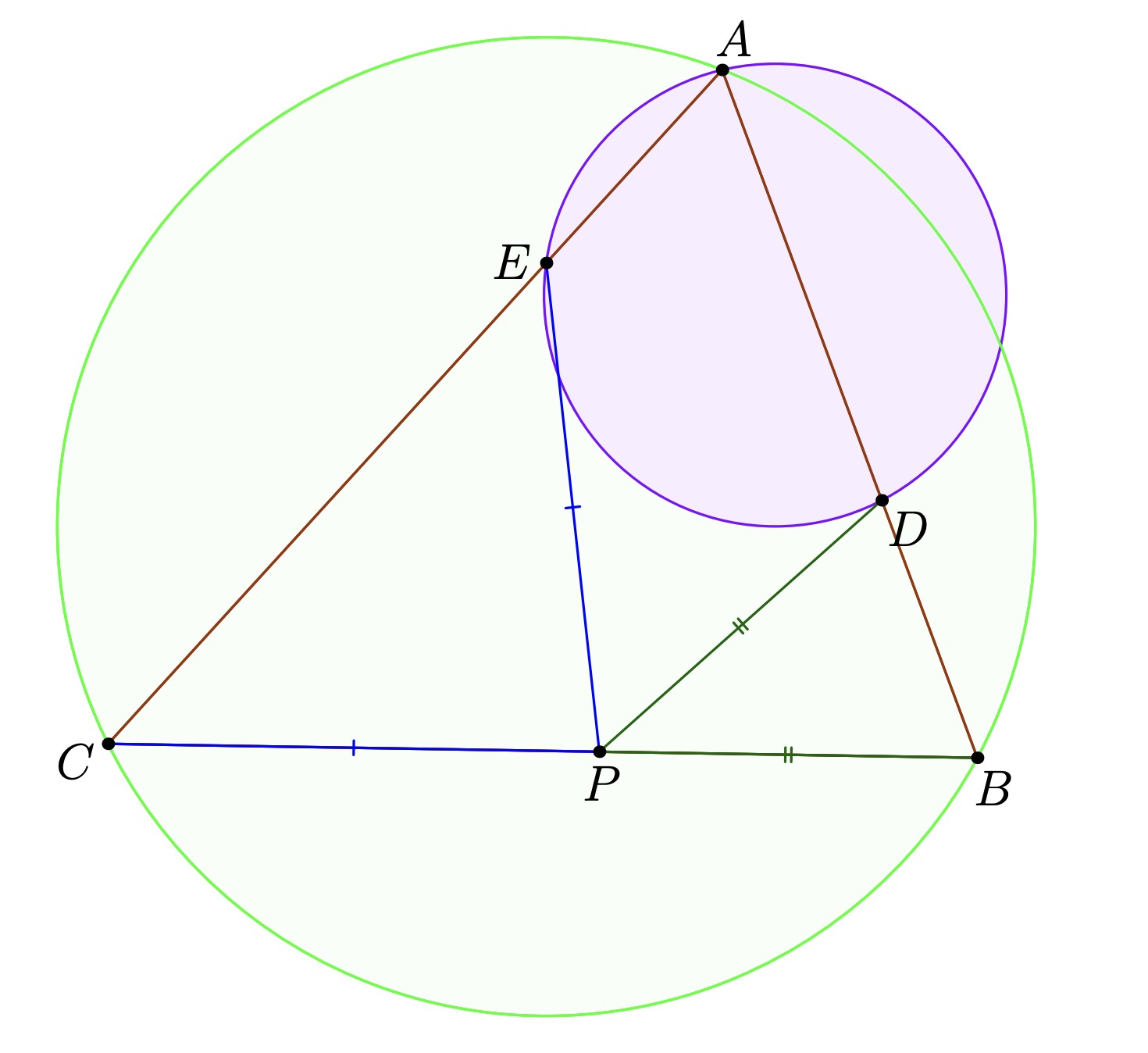
 the lines
 and
 are parallel to two fixed directions, thus by the Generalized
Anchor Point Lemma it must be that
 passes through a fixed point.